Sensitive Skin Facial Cleanser: Where Patch Testing Fits in the Plan
A sensitive-skin claim is a promise, and the client's site states plainly that it needs patch test results. That single line changes how a cleanser project is scheduled: the wording cannot be finished on the strength of the formula alone. Add the published figures, ODM in 4–8 weeks, OEM in 3–6 months and stability and compatibility reports in 3–6 months, and the job becomes fitting the evidence calendar without pushing the launch.

Key takeaways
- A sensitive-skin claim needs patch test results before the wording can be final.
- Stability and compatibility reports take 3–6 months and sit on the same calendar.
- Choose an existing base and the calendar is four to eight weeks; choose something new and plan for three to six months.
- Ingredient sourcing, stability testing and packaging lead time are the published schedule influences.
What a sensitive-skin claim promises
Planning a sensitive skin facial cleanser means planning around evidence. The phrase on the front of the tube is a claim about the people who will use it, not only about the liquid inside. It tells a buyer with reactive skin that the product was checked against that use. That is why the claim is treated as a piece of evidence rather than a piece of copy.
Keeping the promise modest makes it easier to keep. A cleanser that is described as mild and supported by patch test results does more for a sensitive-skin buyer than an exaggerated line that invites a comparison the product cannot win. The aim is a claim the paperwork can stand behind from the first shipment.
Why patch testing belongs on the calendar
Teams often treat patch testing as paperwork that happens once the formula is finished. On a real schedule it is a task with a start date, a sample requirement and an output that gates the claim. Put it on the calendar next to the manufacturing steps and it stops being a surprise.
The client's site is clear that patch test results are needed for sensitive-skin claims, so the claim and the test are linked by definition. If the test slips, the wording slips with it, which is why the test should start as early as the sample allows rather than after the cartons are ordered.
Choosing type and texture for a sensitive brief
The published cleanser options are four types, soap-based, amino acid, compound and exfoliating, and five textures: cream, creamy, gel, foamy and powdered. A sensitive brief usually leans toward the milder end of the type axis and a texture that rinses without leaving a film, but the choice still has to suit the buyer the brand is chasing.
Exfoliating cleansers are the hardest to pair with sensitive-skin language, because the added smoothing step is the part that reactive skin notices. That does not rule the type out, but it does mean the claim and the test have to agree on exactly what the product does. Let the type follow the claim rather than the other way around.
The evidence stack behind the claim
Two documents do most of the work. Patch test results support the sensitive-skin wording, and stability and compatibility reports support the shelf life and the ingredient pairing. Everything else, from sensory feedback to packaging sign-off, sits on top of those two.
| Evidence | What it supports | When it lands |
|---|---|---|
| Patch test results | The sensitive-skin wording on pack | Before any sensitive claim goes to print |
| Stability report | Shelf life and product integrity | 3–6 months |
| Compatibility report | Ingredient pairing at the chosen levels | 3–6 months |
| Sensory evaluation | Texture accepted by the target buyer | Inside the ODM lane of 4–8 weeks |
| Packaging sign-off | Container and closure before filling | Before the fill date |
Notice that only one row is unique to a sensitive claim. The others exist for any cleanser, which means a sensitive brief is not a heavier project so much as a project with one extra gate placed early.
Where patch testing fits against the published windows
Set a launch at week 40 and work backward from the chart. The stability and compatibility report at the outer edge must start by 40 - 26 = 14 weeks, and at the inner edge by 40 - 13 = 27 weeks. Patch testing runs alongside rather than after: because the cleanser formula can already be on file, it starts inside the ODM lane of 4–8 weeks, which leaves 40 - 8 = 32 weeks of runway at the outer edge and 40 - 4 = 36 weeks at the inner edge. The gap between the two report start weeks is 27 - 14 = 13 weeks, exactly the width of the published testing band, and that is the amount of schedule a brand buys by starting the evidence early.
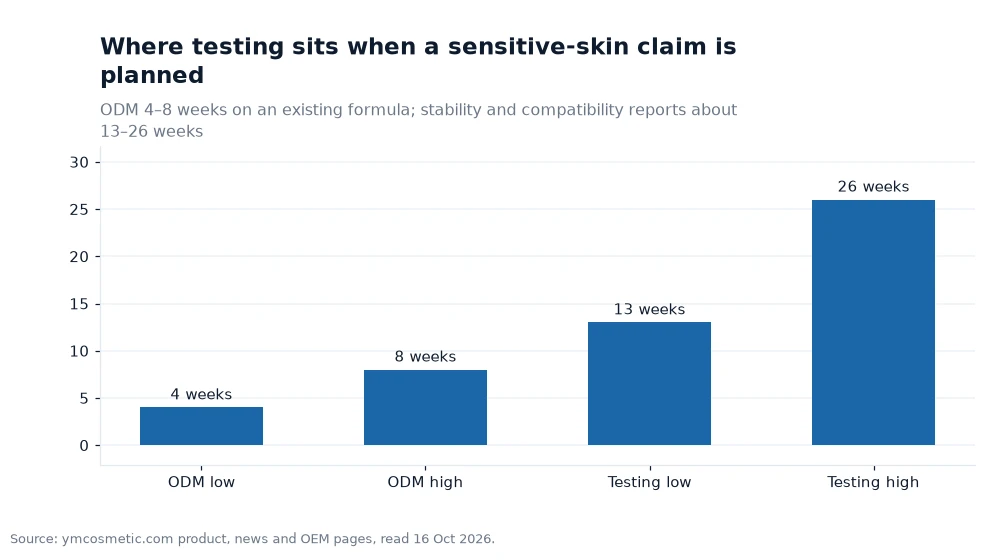
The two bars to read first are 13 and 26. The 13 is the soonest a report can settle the claim, which makes it the earliest realistic date for sensitive-skin wording to be signed off. The 26 is the outer edge and is where a brief that changes its formula mid-project should budget, because every change restarts part of the compatibility work. Anchoring the claim to the formula early is what keeps a launch nearer 13 than 26.
Packaging and sourcing that can quietly delay launch
The site names three schedule influences: ingredient sourcing, stability testing and packaging lead time. Two of them have nothing to do with the formula, which is exactly why they are forgotten. A pump that arrives three weeks late can delay a fill even when the report is already signed.
Order the pack early and keep one substitute container in reserve. If the sensitive-skin claim depends on an airless or opaque format to protect the formula, that decision belongs in the first brief rather than at the sampling stage. Packaging chosen after the actives is how a good formula reaches the shelf in a container that shortens its life.
A launch-ready sequence
Start with the claim, then the type, then the texture. Fix the formula on an existing base so the ODM lane stays at its published 4–8 weeks, and start patch testing as soon as a sample exists. Run the stability and compatibility report in parallel and treat its 3–6 month figure as the long pole on the chart.
Then lock packaging and order the component. By the time the report lands, the container should already be in the building and the wording should already be approved. That sequence removes the two most common causes of a delayed sensitive-skin launch: a late test and a late pack.
Frequently asked questions
Does a sensitive-skin cleanser claim need patch testing?
Yes, the client's site states that sensitive-skin claims need patch test results before the wording can be used.
How long do the supporting reports take?
Stability and compatibility reports take 3–6 months, and the cleanser itself can move inside an ODM lane of 4–8 weeks on an existing formula.
What else can delay a cleanser launch?
The site names ingredient sourcing, stability testing and packaging lead time, so the container should be ordered early rather than after the formula is finished.
Put the evidence on the calendar early
A sensitive-skin launch is decided by when the evidence starts, not by how fast the line runs. Bring the patch test, the stability report and the pack order into the same plan so none of them waits on another. Yunmei supports OEM/ODM cleanser projects with a formula library of over 10,000 mature formulas and published testing windows, and the one-stop OEM and ODM service page shows how testing sits inside the wider production plan. If the range also includes a men's product, the men's face cleanser page covers the type and texture options in the same framework.
All capacity, quality and timeline references come from the manufacturer's own site, read 16 Oct 2026.[1]